Thursday, October 31, 2019
Unit 4 Hippo Video
My Hippo Video
Copy your Hippo video link (not embed code)
Go to your Blog & Click on New Post
Title Your New Post
Click on the Link icon
Type in the text you want to be displayed in your post
Click Link to web Address
Paste Hippo Video link there
Click Test this Link
If good--Click OK
Click Publish in your Blog

Thursday, August 2, 2018
Unit 4: 5 Learning Strategies w/Table
INTRO- This
is what yours should look like below...


What are Learning Strategies?
|
Learning
strategies are the thoughts and/or actions that students use to complete
learning tasks. We all know that good teachers use numerous teaching
strategies to help students learn. We use visuals to introduce new
ideas, we direct students' attention to important elements, and we activate
students' background knowledge before introducing a new concept.
Learning
strategies, however, are the tools that students themselves can employ
independently to complete a language task. For instance, a student who needs
to learn a list of vocabulary
words might draw a picture to remember each word.
It
is important to distinguish between teaching strategies and learning
strategies. Think about yourself in two different roles - as a language
teacher and as a language student. Look at Table 1
below for examples of strategies you might use as a teacher and those you might use as a student.
Learning strategies take different forms. Strategies like Make
Inferences, in which students derive meaning from context, are mental
processes that are difficult to observe. Other strategies
like Use Graphic Organizers/Take Notes can be easily observed and measured. What is important for the purpose of this guide is that strategies can be learned.
Reference(s):
What
are Learning Strategies? (n.d.). Retrieved from National
Capital Language Resource Center (NCLRC) Sailing the 5 Cs with Learning
Strategies, Chapter 2: Defining and Organizing Language Learning Strategies
website: http://www.nclrc.org/sailing/chapter2.html
Table 1
Example:
Field
of Study: Health and Physical Education
|
Strategy
|
Description
|
Teacher
|
Learner
|
Using
Background Knowledge
|
You need to think and use what you already know, and make association to
do the task. By having in mind wat you know, it will be easier to learn newer
information about the material.
|
As the teacher, have the students’ use their prior knowledge about B. F.
Skinner’s Operant Conditioning so that they can obtain or add new information
to what they already know.
|
Think about the information that you already know about a B. F.
Skinner’s Operant Conditioning and add more information to what you already
know.
|
Substitute
or Paraphrase
|
For words or subjects that you do not have knowledge about, you need to
think of similar words or descriptive phrases that help you understand the
new information.
|
Have your students explain complicated words or topics with simple words
or brief descriptions in their own words of what they do not know about it.
|
Find a different way to say your thoughts in simple words, structures,
description, or explain it when you do not know how to say exactly what you
want to say.
|
Personalize
|
New concepts are related or associated to one’s own experiences,
beliefs, feelings, and beliefs, in other words to their own life.
|
Link each example or new material to the students personal experiences
and feelings. Using their experiences can help you transfer the material to
them easily.
|
Relate each example or the material to your personal experiences or
encounters to better grasp the concept.
|
Cooperate
|
By working together, the students can gain the confidence they need and
share their thoughts and be able to complete high quality work with ease. It
lets the students to give feedback to their own individual work.
|
Have the students work with a partner or group to work on a specific
task or project, which will later be presented in front of the class.
|
Work together with your partner(s), share what knowledge you know about
the subject and collaborate in completing the task. Give and receive feedback
about the work you all are doing.
|
Retrieval
Practice
|
Recalling information without the help of the materials, such as books
and notes, helps the students learn the material much more effectively.
|
Have the students put away all their materials away, you can have them
write down or speak as much as possible about everything they know about the
subject.
|
Test your knowledge about the subject by remembering everything that you
know about it. You can either write it down or speak it. Do not be afraid
even if you think you are wrong.
|
Saturday, October 12, 2013
Thursday, October 10, 2013
POST 7: Section 7: New Direction in Instructional Design and Technology
This section of the textbook addresses new directions and
emerging technologies for IDT. For your final post, reflect on how you might
apply each of the following in your current or future position in the IDT
field:
- distributed or e-learning environments
- reusable design or learning objects
- rich media
- emerging instructional technologies, such as artificial intelligence, cybernetics, Web 2.0, virtual worlds, electronic games, etc.
E-Learning Environments
One of the
first things that grabbed my attention in our textbook was that e-learning has
emerged by encompassing all learning that involves technology in any way
possible. It differs from distributed learning, which covers learning
experiences that incorporates technology to bring about learning. One of the
environments of e-learning that I want to pursue as a director of technology is
the concept of learning management systems (LMS). There are so many apps
available to use but one that stands out to me is .LRN. The acronym stands for
Learn, Research, and Network. It is pronounced (“dot learn”) and it is a global
community of educators, designers, and software developers who have come
together to drive educational innovation. It is a non-profit organization
committed to advancing innovation in educational technology through open source
principles.
.LRN provides a comprehensive suite of collaboration tools, a flexible toolset for innovation, and an enterprise-class infrastructure for scalable deployment.
[Gustaf Neumann, Wirtschaftsuniversität Wien]
Reusable Design or Learning Object
This chapter was one of my favorites to
read. The text tells us that a learning object is anything that can be used for
educational purposes. They are building blocks of highly effective instruction,
and they allow instructional designers to produce courses, assessments and
other instructional materials in a way that is flexible, responsive to the
needs of the students and the institution. So in order to save time and money,
effective instructional designers will want to reuse the content and plug-in to
develop an entire curriculum. There are many excellent attributes of learning
objects but there are three that I must have. First, is the learning object
interchangeable? If I can’t retrieve an object and add it to my course without
problems then I do not want it. Second, if the object of learning is not
flexible with many uses then it’s not for me. Lastly, the learning object must
be reusable. Being able to reuse performative learning objects such as quizzes
and assessments helps build self-confidence and belief in the learner.
As stated previously, I would love to incorporate
a Learning Management System (LMS) into the school I work for one day such as
.LRN. There could also be a use for MOODLE. It would help me create an online
working environment. I could include tools such as (interactive quizzes, video,
charts, graphs, text, virtual world simulators, and figures) this would cover
audio and visual learners as well as experiential or kinesthetic learners.
Rich Media
Emerging Instructional Technologies
Rich Media
Our textbook
defines “rich media” as instructional programs that incorporate high-end media
such as video, animation, and audio. If rich media is not benefiting the
learners we should not incorporate it. I
believe that we should always consider the strengths and limits of our client’s
memory and adopt a learner-centered view of instruction that will provide for
more effective learning. I have found an excellent source as I researched how
to use rich media to the success of our students and instructors alike: https://sites.google.com/site/oakwooddigitalacademy/
There are lots of sites and topics to choose from but I will
give you a little taste below…
Create Videos:
Animoto - www.animoto.com
Create videos using text, images, video, and music
Example: www.animoto.com/play/QNC5sGQucGqVQociTcfFpw
Blabberize - www.blabberize.com
Create talking pictures
Example: an example is on the main site at www.blabberize.com
GoAnimate - www.goanimate4schools.com
Create animated cartoons
Example: an example is on the main site at www.goanimate.com
Animoto - www.animoto.com
Create videos using text, images, video, and music
Example: www.animoto.com/play/QNC5sGQucGqVQociTcfFpw
Blabberize - www.blabberize.com
Create talking pictures
Example: an example is on the main site at www.blabberize.com
GoAnimate - www.goanimate4schools.com
Create animated cartoons
Example: an example is on the main site at www.goanimate.com
Voki - www.voki.com
Create small animated cartoons
Example: http://www.voki.com/pickup.php?scid=5621749&height=267&width=200
Create small animated cartoons
Example: http://www.voki.com/pickup.php?scid=5621749&height=267&width=200
Create Presentations:
MyHistro - http://www.myhistro.com/personal-business-education/#education
Create timelines and presentations
Example: https://www.slideshare.net/myHistro/myhistrobasic-guide-for-teachers
Google Drive - drive.google.com
Create documents, presentations, spreadsheets, and forms with an account from Google
Example: https://docs.google.com/file/d/0B0wa1pWj1_OaTUtGS2Y1akhYY00/edit?pli=1
Prezi - www.prezi.com
Create dynamic online presentations
Example: http://prezi.com/zwjvacswsta9/vickis-prezi
LightPDF - https://lightpdf.com/
Turn pdf documents into flippable pages
Example: an example is on the main site at https://lightpdf.com/ MyHistro - http://www.myhistro.com/personal-business-education/#education
Create timelines and presentations
Example: https://www.slideshare.net/myHistro/myhistrobasic-guide-for-teachers
Google Drive - drive.google.com
Create documents, presentations, spreadsheets, and forms with an account from Google
Example: https://docs.google.com/file/d/0B0wa1pWj1_OaTUtGS2Y1akhYY00/edit?pli=1
Prezi - www.prezi.com
Create dynamic online presentations
Example: http://prezi.com/zwjvacswsta9/vickis-prezi
LightPDF - https://lightpdf.com/
Turn pdf documents into flippable pages
Emerging Instructional Technologies
My perspective on emerging instructional
technologies is that it must improve human performance, learning outcomes, and
keep our students engaged. It is obvious that we are moving in a direction that
encourages our kids to be more self-directed in their learning and tools such
as Web 2.0, virtual worlds, and artificial intelligence must empower our
instructors to successfully reach this plateau. Allow me to list some teaching
techniques that will help instructional technologists to achieve this realm:
·
Using
the wealth of online resources
·
Social
learning and collaboration
·
Adaptive
learning
·
MOOCS
·
Professional
development in technology integration
·
Flipped
classroom tools
·
Adaptive
learning Sunday, October 6, 2013
POST 6: Section 6: Getting an IDT Position and Succeeding At It
ETEC 561 Post 6: Section 6: Getting
an IDT Position and Succeeding At It
This section of your textbook focuses on jobs in the
profession of instructional design and technology: lessons and tips on how to
get one and organizations that can support the job search and continued learning
in the IDT field. Many of you already have a job in the field or in a related
field; however, based on this week’s readings, you’ll reflect on where you are,
where you want to go, and what you need to learn or do to get there.
Begin your post for this week
with some background: what is your current job, what program are you enrolled
in, what brings you to that program, and what do you expect when you graduate
(change jobs? obtain a promotion?).
My current job is that of being a graduate assistant for
Dr. Julia Ballenger & Dr. Madeline Justice in the Educational Leadership Department.
The program I am enrolled in at Texas A & M University-Commerce is the Master
of Science program in Educational Technology and Leadership (ETLD). I have a love for students and seeing that
they obtain the best in their education possible. I want to be able to
integrate technology, new or old, into the classroom so that every student will
improve on an individual basis. Then I’d love to develop curriculum, and train
others (teachers and administrators) to implement everything I’ve designed. I
plan to graduate in the summer of 2014 and pray that a job as a Manager of
Educational Technology and Integration will be forth coming. I am considering
furthering my education with a second masters then pursue a doctorate degree.
Next, describe the kind of work
that you want to do and the type of organization or institution in which you want
to work. Use the WorkMatrixTM in the chapter titled “Getting a Job in Business and Industry” to
help organize your thoughts. Do you most desire first, second, third, or fourth
level service? Or would you rather design or develop instruction? What features
of work are important to you? What economic sector do you want to work in?
The kind of work I am most interested in is technology
design/development integration. The education field is the institution I want
to work in. After completing the WorkMatrixTM, my desire is 2nd
or 3rd level service, designing then developing in order of
importance. I want to be in close proximity of my work because I am not a big
fan of traffic stress, so the geographic feature is very important to me. The
economic sector that I want to be and stay involved in is education. The
benefits include helping students, teachers, administrators, and who can forget
the weekends, holidays, and summers off. I am a lifelong learner and I want to
promote and leave that legacy.
Based on these intentions,
explain what you need to learn. What skills and qualifications do you need?
Will you obtain the skills you need in the required courses in your program?
What electives might you need to take to help you develop skills specific to
your aspirations?
Since my interest in Instruction Technology Integration
is so prevalent, my job would be the application of technologies to improve
human performance learning so I must stay updated with the intersection of
technology and education. The main skills and qualifications are in knowing
strategic methods to identify what should be taught and how to teach it. I need
to be up on instructional systems design. The key would be in knowing how
instruction is designed, developed, and implemented. Skills valuable when
working with faculty and staff would be knowing how to negotiate well, knowing
how to deal with difficult participants, and definitely knowing how to
integrate technology into the curriculum. To top off everything previously said
it would be smart having effective research skills, knowing the content and
presentation of courses, being a consultant as one works with worthwhile
research, and finally be able to review papers for scholarly publications and
conferences. The electives I’m taking for my masters will be Instructional
Design and Development (Design), Issues in Educational Technology and
Technological Change (Implementation), and Technology and Inquiry Based
Instructional Methods (Design). I have an elective that I took last summer
entitled Leading Effective Schools. These are the classes I know will help me
achieve the skills necessary to begin my journey into Educational Technology.
Finally, what organizations would
best support your continued learning after you graduate? Do you think you would
benefit from joining those organizations before graduating? Explain why or why
not?
After reading
chapter 28 in our textbook, there are many professional organizations that
support education. Currently I am a member of the National Society for
Leadership and Success at TAMUC. There are three organizations I would like to
join right away because I believe they will best support my field the
best. The Association for Educational
Communications and Technology (AECT) is a professional association of thousands
of educators and others whose activities are directed toward improving
instruction through technology. It provides an international forum for the
exchange and dissemination of ideas for its members and for target audiences;
it is the national and international spokesperson for the improvement of
instruction; and, it is the most recognized association of information
concerning a wide range of instructional and educational technology. I would
get more benefits by joining AECT.
Ø
Professional
and Staff Development and Connections
Ø
Publications
and Resources
Ø
An Open
Content Portal, developed by interns and operated by the Graduate Student
Assembly, provides a resource by which educational technology scholars and
researchers can share how they teach and what they teach in their courses
Ø
Awards
and scholarships are available through the Educational Communication and
Technology Foundation
Ø
Mentoring
opportunities can be arranged
Ø
Members
qualify for a discount on Geico automobile insurance
Next I would like to be part of The International Society
for Technology in Education (ISTE®). It is the premier membership association
for educators and education leaders engaged in improving learning and teaching
by advancing the effective use of technology in PK–12 and teacher education. ISTE
membership is a powerful and meaningful way for educators to connect with
peers, to gather in a variety of forums to share the challenges and excitement
of teaching, and to be part of a community that leads the transformation of
education. As a member, I would get the following benefits:
Ø
Learning
& Leading with Technology magazine
Ø
ISTE's
member communities and special interest groups (SIGs)
Ø
Members-only
resources
Ø
NETS
resources
Ø
ISTE
journals: JRTE, JDLTE, and JCT
Ø
ISTE
books discount (30% off)
Ø
ISTE webinars
discount (60% off)
Ø
ISTE’s
annual conference and exposition registration discount
By attending ISTE's annual conferences, it allows me to
enter more than 200 concurrent spotlight and
lecture sessions, 300+ poster, student showcase, and
global collaboration stations, themed networking
lounges.
The final group would be the American Educational
Research Association (AERA). It is a national research society that strives to
advance knowledge about education, encourages scholarly inquiry related to
education, and promotes the use of research to improve education and serve the
public good. The benefits include:
Ø Within
the AERA community of education researchers, members belong to one or more of
the 12 divisions and over 160 special interest groups (SIGS),
Ø Graduate
student members also enjoy ongoing communication and support provided by the
Graduate Student Council (GSC),
Ø
In addition, the Organization of
Institutional Affiliates (OIA) provides a forum for academic institutions,
departments, non-university-based research institutions, and professional
associations to share information about federal education research issues,
people, and events, as well as to be engaged in shaping policy with regard to
significant research issues.
Sunday, September 29, 2013
POST 5: Section 5: Trends and Issues
Chapters in Section V identify
trends and issues in IDT in various contexts: business and industry; military;
health care education; P-12 education; and post-secondary education. Select at
least 3 of these 5 contexts and compare/contrast the IDT trends and issues.
Then explain how they are similar or different from the IDT trends and issues
in the context in which you work.
In my fifth post I
will be covering issues and trends related to business and industry,
health-care education, and P-12 education.
Instructional
designers today must embrace more than simply producing instruction. The
affiliation includes analyzing human performance problems, identifying their
root causes, coming up with solutions for these root causes, and finally
incorporating these solutions to actually fix the issues at hand.
Business and industry
There are many
issues for an ID to be aware of related to business and industry. Allow me to
focus on a couple. The biggest factor facing all these contexts is that of
time. Every client wants their problem fixed yesterday. When time is not on
your side as an ID you will feel the constraints that include a lack of time,

lack of support from your client, and a lack of money to provide everything the ID needs to accomplish the job. ID may be working solo or as part of a team. No matter what the setup, always be ready to prove your wares with a specific proposal that dictates what you believe it will take to produce the optimal ID product. The trends of business and industry would be the growth and expansion of corporations beyond individual country boundaries, demands for design cycle time reduction, and increased effectiveness and efficiency of training.
lack of support from your client, and a lack of money to provide everything the ID needs to accomplish the job. ID may be working solo or as part of a team. No matter what the setup, always be ready to prove your wares with a specific proposal that dictates what you believe it will take to produce the optimal ID product. The trends of business and industry would be the growth and expansion of corporations beyond individual country boundaries, demands for design cycle time reduction, and increased effectiveness and efficiency of training.
Whereas the issues
that ID’s must address are how to work cross-culturally, completing training
design and development quicker, ensuring that successful training is delivered
in a prompt fashion, and positively affecting the profit margin of the company.
Health-Care Education
The medical field
has been the leader in developing performance and instruction methods (p.203).
The medical field is moving from a traditional training method to problem-based
curricula where training is in the context of clinical cases. The more recent
movement for evidence based medicine (EBM) is taken from
 problem-based
learning. It involves formulating clinical questions, finding the answers as
evidence from the literature that is related to the questions, assess the
evidence, and then apply the solutions to the patient. Finally, another dimension of helping or care
giving is some medical schools hire actors to portray or mimic varied diseases
and the medical students have to interview and examine these actors to try and
discover the illness being portrayed.
problem-based
learning. It involves formulating clinical questions, finding the answers as
evidence from the literature that is related to the questions, assess the
evidence, and then apply the solutions to the patient. Finally, another dimension of helping or care
giving is some medical schools hire actors to portray or mimic varied diseases
and the medical students have to interview and examine these actors to try and
discover the illness being portrayed.
To sum up, the
trends for health care are clinical reasoning, problem-based learning, and
evidence-based medicine. That takes us to the issues being knowledge and
research, costs and managed care, regulations and standards, and convergence.
P-12 Education
Since the beginning of the computer age,
instructional designers have directed their efforts to helping teachers
integrate technology into the classroom with the main focus of improving
student education and learning. Technology is now incorporated into every
aspect of instructional delivery and many school
 operations. Instruction
technology covers everything from reporting of student progress, student assessments,
grading, to individualized instruction on an ongoing basis. Larger amounts of
time are given to core classes and their instruction. Schools are going greener
and greener. Our schools want to protect our environment and teach our kids how
to do this. With all these trends some might want to turn tail and run. But the
best thing we can do is use these trends as a starting point to where educators
can “think outside the box,” to ask “what if’, and to “consider the
unconsidered”.
operations. Instruction
technology covers everything from reporting of student progress, student assessments,
grading, to individualized instruction on an ongoing basis. Larger amounts of
time are given to core classes and their instruction. Schools are going greener
and greener. Our schools want to protect our environment and teach our kids how
to do this. With all these trends some might want to turn tail and run. But the
best thing we can do is use these trends as a starting point to where educators
can “think outside the box,” to ask “what if’, and to “consider the
unconsidered”.
The trends with
P-12 education are instruction design technology, which is to achieve learning
and performance outcomes through the use of such models as ADDIE. Classroom
level technology integration models with the likes of ASSURE model, dynamic

instruction design (DID), the iNtegrating technology for inquiry (NTeQ) model, and technology integration planning (TIP) model.
instruction design (DID), the iNtegrating technology for inquiry (NTeQ) model, and technology integration planning (TIP) model.
The issues cover
but are not limited to NCLB Act of 2001 taking a closer look at student
achievement and teacher performance via technology integration. Technology
integration is closing the gap by meeting the technology requirements to
prepare today’s students for tomorrow’s careers, and lastly learning and
thinking skills are improving.
In Conclusion
In each of these fields it is easy to compare and contrast trends and
issues. The professional instructional designer must be able to think on their
feet. Be able to problem-solve, communicate, come up with creative ideas when
constraints are placed before him/her. When the rubber meets the road the ID
must be able to transfer learning efficiently and effectively all the while
training others to be able to carry out their plan of action. Since I am not
officially working, my dream job would be that of a director of technology for a
school district. I would be the one that made sure every teacher or
administrator alike was integrating technology as efficiently as possible so
the maximum improvement on human performance was being achieved. Let’s don’t
use technology just for the sake of using it, let’s make sure our students are
learning at top notch.
All 3 of these fields are similar to the field I want to work in. Desiring
to be a designer of instruction the trends and issues that these fields face
will be quite similar to my work environment. Every boss wants more bang for
his/her buck. When a project is proposed and agreed upon, as an ID time is of
the utmost importance. Problem-solving, training, ethical practices, and most
importantly improving human performance in a most tangible way!
Sunday, September 22, 2013
POST 4: Section 4: Human Performance Technology
Not all problems in learning and/or performance require an
instructional solution. Many times a non-instructional approach is a more
appropriate solution. This week’s reading and reflection focuses on human
performance, performance support systems, knowledge management systems, and the
concept of informal training.
1. Chapter 14 discusses the concept and
evolution of human performance improvement. Several sections of chapter 14
present a variety of non-instructional solutions to performance problems.
Identify a performance problem in your area of work and identify non-instructional
solutions that may help solve the problem.
One of the biggest problems I faced while being a
substitute physical education teacher was taking the attendance for every
class. The secretary had to copy off every classes roll for the entire school.
Then each attendance sheet had to find its way to every teacher so the roll
could be taken. Each teacher then had to call out each student’s name to
determine if they were present or absent. The teacher had to place an A beside
those kids who didn’t answer, sign the document, and then take or have someone
run it back to the secretary for implementation. What a poor way to keep up
with this problem when there are so many other ways to make this process
easier.

Let me suggest a couple of ways that I’d use
to solve this problem. The first system I’d use would be Google Docs. I could
create a Google Docs sheet to track attendance in my class, then when I finished
taking roll I could send it to the secretary via computer, iPhone, iPad, etc.
Any tool that had internet capability could be used to work with Google Docs. Also
every teacher could do the same and this would save lots of paper waste, time
to copy off each roll and wasted time delivering these. Not only could the secretary
track attendance but so could the Principal, Vice Principal, and
Superintendent.
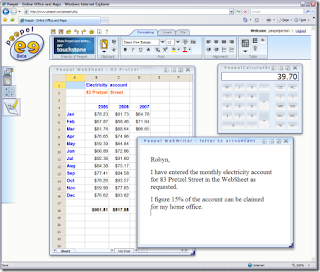

The second option I would use
to solve this problem is a similar system to Google docs and that is Peepel. Peepel is
basically a whole suite of desktop applications, stored within your browser.
You can run multiple Peepel windows in the same browser window, letting you
manage more pieces of your workflow all at once. Peepel offers services like
the WebWriter word processor, WebSheet for spreadsheets, a contact manager,
great file-sharing and collaboration tools, and the Workspace Manager that lets
you save your layout and return to it later.
2. Chapter 15 presents performance support
systems. Define performance support systems and explain how a performance
support system might (or might not) help solve the problem you identified above.

Performance system approach is defined
by Villachica, Stone, and Endicott (2006) as “an optimized body of integrated
on-line and off-line methods and resources providing what performers need, when
the need it, in the form they need it in” (p.540).They also acknowledged the
range of definitions and terminology (electronic performance systems,
performance support, EPSS, PSS, PST). They also argue that the goal of
performance support was universal: “expert-like performance from day 1 with
little or no training”.
I found a model called the D4M2 model that has six phases. As the acronym
shows (define, design, develop, deliver, manage, and measure). I believe this
model would help me with my problem.
The define phase is where I would identify any problems and make sure
all parties were in agreement.
The design phase is where I’d design the EPSS blueprint taking into
consideration everyone that will be using this and formatting it to fit their
needs.
The develop phase is where I would develop my EPSS system using Peepel
or Google Docs…test it and send to everyone so they can attempt it to see if
all the bugs or questions are fixed/answered.
The deliver phase is where I would present my EPSS in our weekly
teachers meeting or staff meeting. Training for all would be my mission.
The final two phases manage/measure is where I would constantly monitor
my system and make sure everyone was using it to produce the maximum desired
outcome it was designed for and send out any updates or needed fixes required
to make sure it runs wonderfully smooth.
3. Chapter 16 explains knowledge management: the
way we manage information, share that information, and use it to solve
organization problems. Organizations, such as schools, accumulate a great deal
information/data, which must be organized in a way that we can make sense of it
in order to use for making decisions. What knowledge would help solve the
problem you identified above and how would that knowledge need to be collected
and managed to help facilitate problem solving?

Our textbook tells us that “Knowledge Management” is defined as a
revolution in the way we manage information. More practically, for training/learning
professionals, it changes the way we see the boundaries of our practice, from
the tools and processes we use to our sphere of influence and the impact we
make in organizations. In our jobs we create tables and relationships,
presentations and documents, websites and databases where data is transformed
into information and ultimately internalized into knowledge.

For the
issue I have mentioned above I can create a knowledge management system. For
the codification portion, I can set up training materials so everyone can have
easy access in the forget how to do something previously taught. I can install
a FAQ on the school website for the EPSS. For the collaboration portion, I’d
setup luncheons, so everyone using the tools can socialize and learn from each
other as they socialize over a meal. This could be called our “communities of
practice”. Finally, the access portion would be a community site like “My Yahoo”
where everyone could a synchronize knowledge in a common portal. My goal would
be to give my users the ability to access knowledge anytime and anywhere.
4. Chapter 17 describes types of informal
learning. What informal learning experiences have you participated in at your
organization? Could those informal learning experiences be shared with others?
Could the knowledge gained in those settings be codified and managed? And
should it be managed or should the informal experiences be replicated or
broadened to include others?

I believe that informal learning is occurring
all the time! Our text tells us that the work of the instructional designer is
to integrate aspects of informal learning into our plans, and in doing so,
enhance authenticity, experience, conviviality, peer interactions, and even spontaneity
in learning experiences (Allison). I have participated in informal learning
experiences by going to the zoo, bible museum, and the Planetarium. At first we
don’t realize all that we learn informally from these activities but as we put
together our photos and reflections of all the events seen on the school’s
website, or Twitter, or Facebook, students discover their love for animals,
space or the bible. These activities should be duplicated and definitely shared
by others.
Subscribe to:
Posts (Atom)